Kaltura My Media – Extended Audio Descriptions
Extended audio description pauses the video as needed to provide detailed narration of key visual elements, making content more accessible to viewers with vision impairments. EAD’s can be added and edited for Kaltura entries under the Caption Tab of an entry’s Edit Page.
Add an Extended Audio Description (EAD)
You can upload Extended Audio Description (EAD) files for any of your entries in My Media. EAD files are time‑coded text files that the Kaltura player converts into spoken narration using the browser’s built‑in speech synthesis. This feature makes visual content accessible for users who are blind or have low vision.
EAD files must be uploaded in VTT format and are managed from the Captions Tab, alongside caption files, using a dedicated upload option.
Upload an extended audio description file
- Click Add extended audio description.

- The Upload extended audio description window opens.
- Click Browse and select a VTT file from your device.

- Select the appropriate Language from the dropdown menu.
- Enter a Label (recommended: add an “EAD” suffix to clearly identify the file).
- Click Save to upload the file.

The uploaded file will appear in its own table within the Captions tab. To upload another, click Add extended audio description and repeat the steps.

Actions
For extended audio description files, the following options are disabled:
- Display on player
- Set as default
Delete an extended audio description file
- In the captions table, locate the EAD file and click the X in the same row.

- A warning message appears: Are you sure you want to delete this file?
- Click Delete to remove it.
Download an extended audio description file
- Click the download icon in the file’s row. The file downloads to your device (default filename is typically “English.vtt,” which you can rename).

Edit Extended Audio Descriptions
Kaltura’s Extended Audio Description (EAD) editor lets you review and edit EAD files for your videos. EAD files are time‑coded text files that the Kaltura player converts into spoken narration using your browser’s text‑to‑speech engine. Editing an EAD file allows you to refine descriptions, adjust timing, and improve accessibility for viewers who rely on audio descriptions.
EAD files are uploaded in VTT format and are edited using the same interface as captions. Editing an EAD file does not change how it behaves during playback.
To begin:
- Click Edit captions.

- In the drop‑down menu, select the EAD file you want to edit.

Editor Layout

The editor has two main areas – the audio descriptions panel and the player panel.
Audio descriptions panel
This panel lists all description cues and includes tools for editing them:
- Audio description file selector – If the entry includes more than one EAD file, you can select the file you want to edit from the list.

- Edit details – Update the file’s language, accuracy, or label.
- Search field – Enter a term and press Enter to highlight matches.

- Replace – Find specific words or phrases and replace them across the file.
- Autoscroll – Follows the cues automatically as the media plays.
- Delete cue – Hover over a cue to display the trash icon, then click to delete.
- + Add audio description – Hover over any cue row to add a new one.
- Timestamp – Click to edit start or end times in SMPTE format (hh:mm:ss,mmm).
- Text field – Click inside any cue to edit the description text directly.
Player panel
The player panel displays the media and plays back audio descriptions using the browser’s text‑to‑speech voice.
When you select an audio description cue, the player jumps to the corresponding timestamp so you can sync the narration with the visual content.

Editing options
EADs are active from their start time to their end time. If a viewer skips to any point within that range, the description will play.
To ensure accurate playback:
- Set the start time at the moment the described visuals begin.
- Set the end time when the scene ends.
- Even if the spoken narration begins earlier or ends later, the defined cue times determine when the description is triggered.
Always confirm that the end time matches the visual scene, so descriptions play correctly when viewers skip during playback.
Edit audio description details
- Click Edit details.
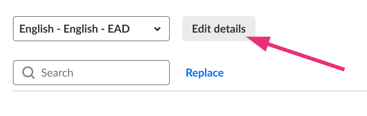
- Update the language, accuracy, or label.

- Click Save. The information updates immediately.
Find and replace text
Use find and replace to quickly update wording across multiple audio description cues, such as fixing typos, correcting names, or standardizing phrasing.
- Click Replace.

- Enter your search term in Find match.
- Enter replacement text in Replace with.

- Click Replace, then Save.
- When prompted, adjust the accuracy slider and click Save

Add an audio description
- Hover over a row until + Add audio description appears, then click it.

- Edit the new cue’s text.

- Adjust timing so cues do not overlap (timing conflicts display in red).

- Click Save, confirm accuracy, and click Save

Edit an audio description
- Click the cue’s text field to activate editing.

- Make your changes.
- Click Save, then confirm accuracy and Save

Related Posts